Dissecting Stake Weighting Formulas That Shape Promo Credit Value Across UK Bookmaker Platforms
Alex Krüger · Aug 22, 2026
Dissecting Stake Weighting Formulas That Shape Promo Credit Value Across UK Bookmaker Platforms
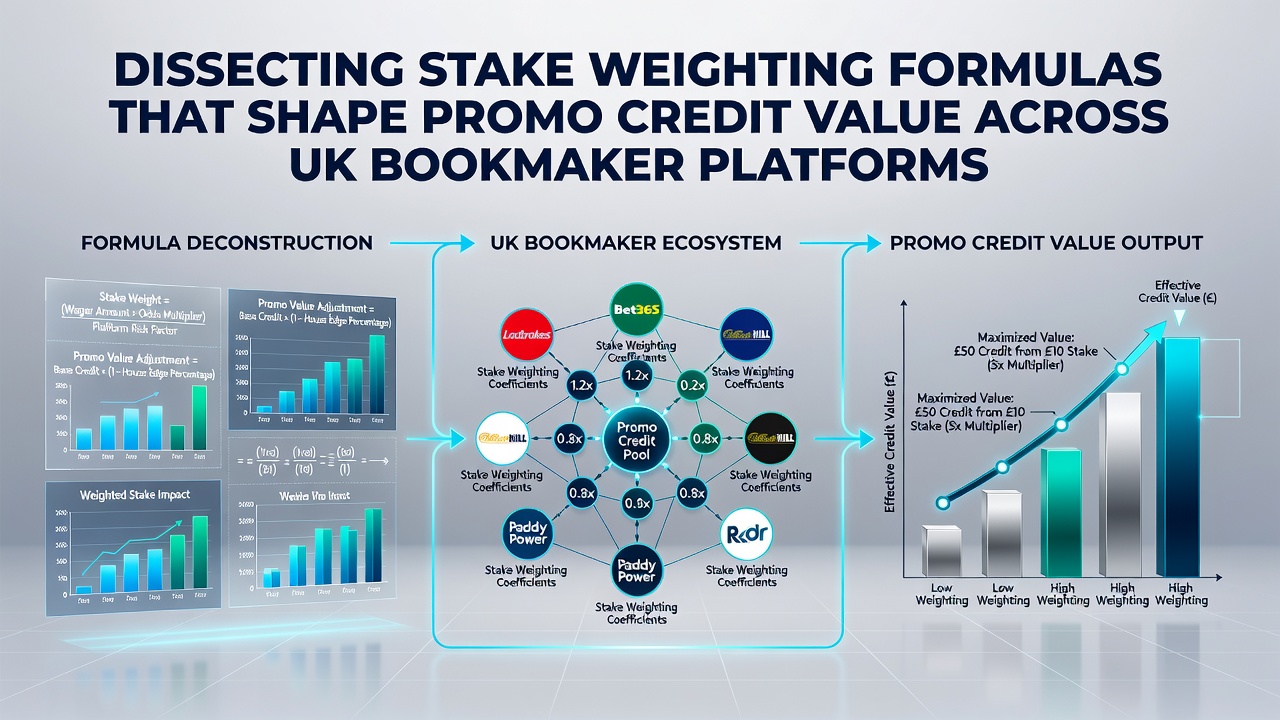
Stake weighting formulas determine how much of each wager counts toward promotional credit requirements at UK bookmaker platforms, and these calculations vary widely depending on the operator and the specific offer in play. Different bet categories receive distinct multipliers that reduce or enhance the effective contribution, which means a £10 stake on one market might advance the requirement by only £2 while the same amount on another market advances it by the full £10. Observers note that these formulas emerged as operators sought to balance customer incentives with risk management, and data from industry analyses show the practice has become standard across major platforms since the mid-2010s.
Core Components of Stake Weighting Systems
Most weighting systems begin with a base rate of 100 percent for straightforward accumulator or single bets on sports, yet they apply steep reductions to other categories such as live in-play markets, certain casino games, or virtual sports. Researchers have documented cases where table games contribute only 10 percent or less toward rollover targets, while slots often maintain full weighting. This structure directs player activity toward products that carry lower house-edge volatility for the operator. Those who have examined multiple platforms find that the exact percentages shift periodically, sometimes in response to seasonal promotions or changes in product availability.
Take one platform that lists its terms with a tiered table: football singles at 100 percent, tennis at 80 percent, and esports at 50 percent, while another applies a flat 20 percent rate to all non-sports wagers. These differences create measurable variations in the real value of a promotional credit because the time required to clear the requirement changes accordingly. Figures from comparative reviews reveal that accounts using lower-weighted markets can take three to four times longer to satisfy the same wagering threshold.
Platform-Specific Variations and Their Effects
Operators in the UK market have each developed proprietary adjustments that reflect their product mix and customer demographics. One major site applies an additional multiplier for bets placed via mobile apps versus desktop, whereas another reduces weighting on high-odds selections above a certain threshold. Data shows these tweaks influence how promotional credits convert into withdrawable funds, with some users finding they must adjust their usual betting patterns to optimise progress. What's interesting is that the same stake can produce different effective contributions on two platforms even when the headline bonus amount appears identical.
Examples from Leading Operators
Platform A weights horse racing at 75 percent but drops greyhound racing to 40 percent, while Platform B reverses those figures. Users who follow both sets of rules often discover that switching between sites requires recalculating their expected clearing time for each new credit. A separate operator introduced a seasonal adjustment in August 2026 that temporarily raised weighting on cricket markets during the international summer schedule, producing a short-term spike in activity on those events. Such targeted changes demonstrate how formulas remain fluid rather than fixed.

According to research published by the Responsible Gambling Council, weighting systems can alter the perceived generosity of an offer by as much as 35 percent when measured against actual funds released. Another analysis from the Australian Gambling Research Centre reached similar conclusions when comparing international operators, noting that transparent publication of weighting tables correlates with higher customer retention on promotional offers. Those findings underscore the practical impact of the formulas on both sides of the transaction.
Mathematical Structure Behind the Formulas
The typical calculation multiplies the stake by a category-specific percentage, then adds the result to a running total that must reach the required threshold. For instance, a £50 stake at 40 percent weighting contributes £20, so four such bets would be needed to cover a £80 requirement. Some platforms layer secondary rules, such as minimum odds that must be met before any weighting applies, or caps on the maximum contribution per bet. These additional constraints prevent users from clearing requirements with a single large wager on a heavily weighted market.
Experts have observed that the formulas also interact with other terms, including minimum bet sizes and time limits. When a platform sets a seven-day expiry on a credit while applying low weighting to popular markets, the effective value drops because fewer bets can be completed within the window. Data indicates that users who study the weighting tables before accepting an offer achieve higher conversion rates than those who proceed without that information.
Conclusion
Stake weighting formulas continue to evolve as UK bookmaker platforms refine their promotional structures, and the differences across operators remain significant enough to affect the actual value delivered to account holders. Comparative data and regulatory-adjacent research both confirm that understanding these calculations allows for more informed decisions about which credits to pursue. As platforms update their systems, including the adjustments noted in August 2026, the underlying mathematics stay central to how promotional credits translate into usable funds.